RetroYugi / Community platform
An old-school game. A new home for its community.
A complete platform for a custom, old-school Yu-Gi-Oh! format. Explore a searchable card pool, discover curated decks, and learn the rules behind the game — brought together in a full build delivered in two weeks.
The challenge and my contribution
Business context and objective
A custom Yu-Gi-Oh! community format needed a connected home for card discovery, deck exploration, rules and community information.
My contribution
I built the complete platform, bringing searchable cards and filters, illustrated decklists, rules and editorial pages into one responsive experience.
Technical approach
Responsive interfaces, card search and filtering, deck-library journeys and connected editorial content.
Documented outcome
The complete platform was delivered in two weeks. The client review below describes the collaboration; this project-specific delivery time is not the standard MVP offer.
Explore MVP development →RetroYugi / The platform
Built around
the way they play.
A familiar game, a thoughtfully different format, and a place for players to discover both.
- Delivery
- 2 weeks
- Scope
- Full build
- Today
- Live platform
The challenge
A home for
an entire format.
RetroYugi takes the nostalgia of early Yu-Gi-Oh! and gives it a distinct set of rules and curated decks. Its focus is on reading the game, adapting and mastering a deck, with a format designed to support varied play.
That creates a product challenge: the website has to introduce the idea to newcomers and work as a practical reference for players who already know the game. Cards, decks and rules need to be easy to move between.
I delivered the full platform in two weeks, bringing the card database, deck library, editorial content and community pages into one responsive experience.
The experience
From “what is this?”
to “let’s play.”
Four connected parts of the platform, built around the questions a player brings to the game.
A card pool you can actually explore.
Players need to know more than a card’s name. They need to understand where it fits in this particular format. The card browser brings familiar game attributes and RetroYugi’s own properties into the same search experience.
- Search cards and switch between grid and list views.
- Filter by card type, level, limitation status and format properties.
- Narrow attack and defence ranges, then sort the results.
Start with a deck. Find your own way to play.
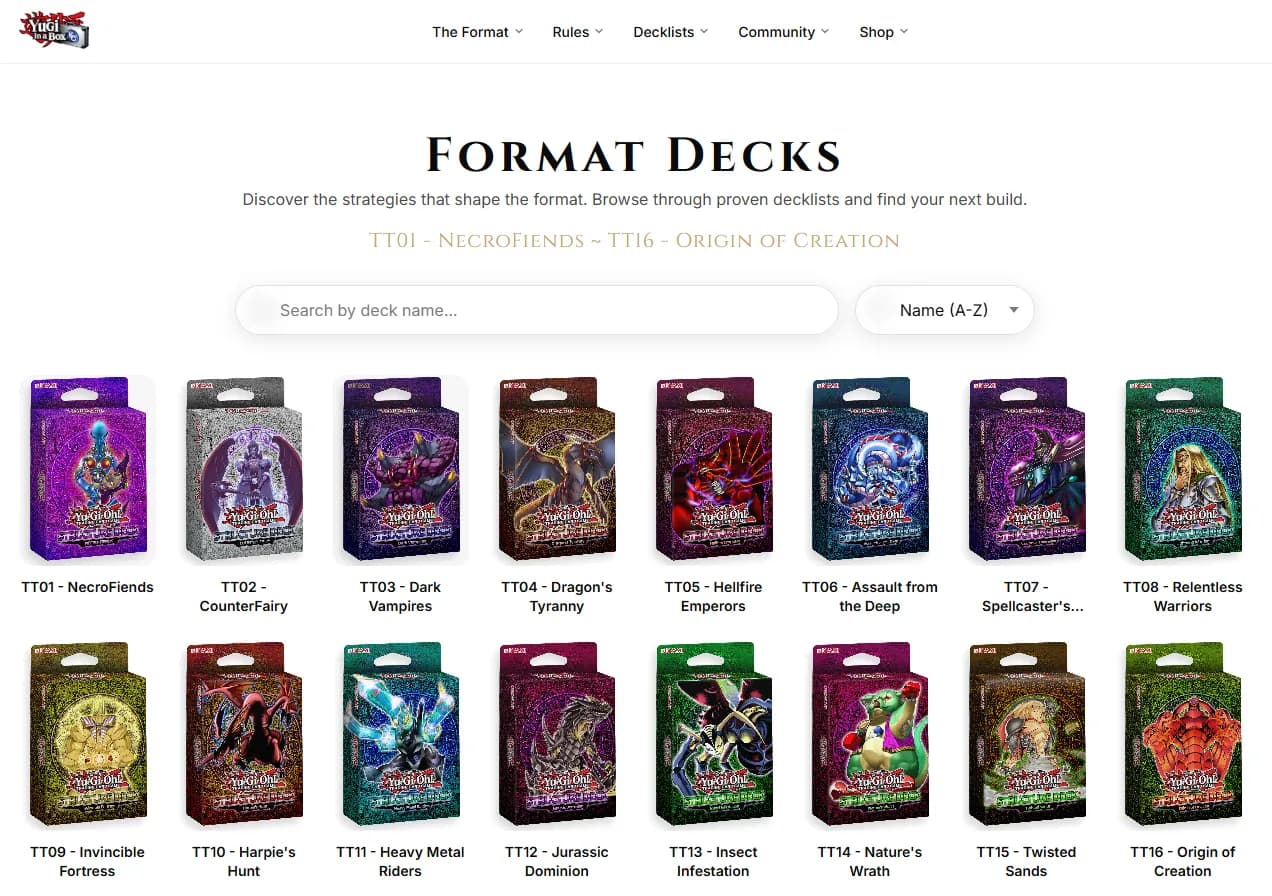
RetroYugi centres on pre-constructed decks, with an emphasis on player skill, adaptability and learning the cards you have. The deck library gives each strategy a recognisable visual identity and a place to explore its list.
- Browse illustrated decks grouped into numbered collections.
- Search by deck name and sort alphabetically.
- Open individual decklists to explore a strategy in more detail.
Make a custom format easier to understand.
An alternative format comes with its own vocabulary. Rules and editorial content give players a way into those ideas, while card-level status information keeps the format’s distinctions close to the cards themselves.
- Rules and changelogs covering format updates and card-pool changes.
- Editorial explanations of mechanics such as Restricted Tokens.
- Visible limitation and special-property information in the card pool.
Give the whole project a front door.
The website connects the game to the people around it. Visitors can learn who is behind the format, find contact and collaboration pages, and reach the community’s social channels from the same place.
- A homepage connecting cards, featured decks and recent articles.
- People, contact and collaboration pages.
- Links to Discord, YouTube, Instagram and project support.
A format with its own logic
The game’s details
belong in the product.
A general card catalogue would only tell part of the story. RetroYugi’s own rules and card properties need to be visible wherever players explore the format.
- Discover
Find a card or a deck.
Search and filtering turn a large collection into a manageable starting point.
- Understand
See its place in the format.
Limitation status and special properties add context beyond a card’s basic stats.
- Learn
Connect the rules to play.
Editorial explanations introduce ideas such as a limited pool of Restricted Tokens for powerful cards.
Delivery & follow-through
A complete build.
A close collaboration.
The work connected several different content types: card records with format-specific attributes, decklists with their own artwork and detail pages, and articles explaining the game. A shared visual language keeps those journeys recognisable as parts of the same platform.
The two-week delivery brought those pieces together in a live website. The collaboration also included adapting to feedback and following through as the project took shape — the part Luca highlights in his review.
Explore the live RetroYugi platform (opens in a new tab)In the client’s words
The experience behind the delivery.
Working with Chirag on RetroYugi was a great experience overall. Super available, helpful and easy to work with from day one. What I appreciated the most was definitely the follow-up care and his adaptability during the whole process — always present, quick to adjust when needed and proactive in finding solutions.
Explore the cards, decks and format on RetroYugi’s live website (opens in a new tab).